Table of Contents
- The document paradox: data abundance, insight scarcity
- From storage to activation: the role of AI
- How AI transforms documents into knowledge
- Use cases: where impact is immediate
- Beyond efficiency: a cultural shift
- Challenges to address
- The future: documents that work for people
- Conclusion
It usually starts the same way.
You know the document exists. You’ve seen it before. Maybe it was shared in an email, or saved somewhere in a shared drive, or buried inside a folder with a name like “final_v3_updated_latest”.
So you start searching.
Ten minutes turn into thirty. You open three similar files, none of them clearly the right one. At some point, it feels faster to just recreate the document from scratch.
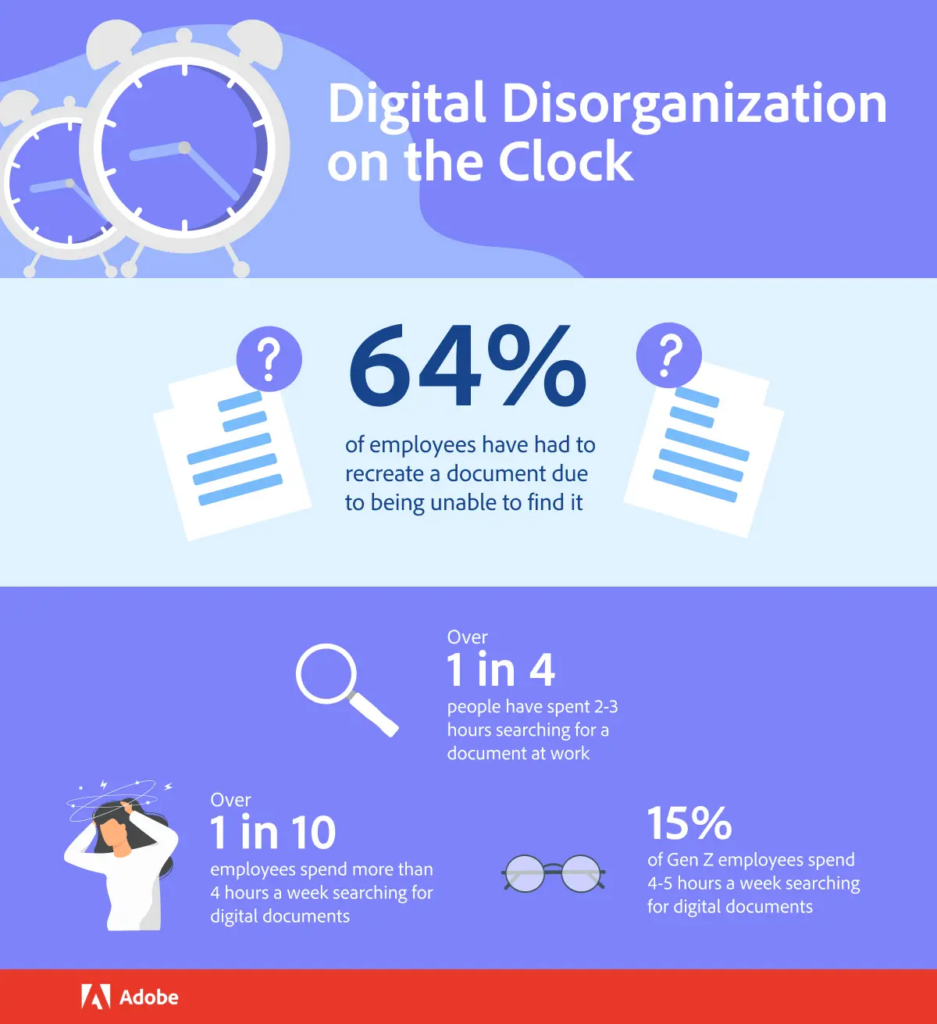
Employees spend up to 30% of their workday just trying to find information. Nearly two-thirds have had to recreate documents that already existed. And almost everyone has felt the frustration of not being able to access the knowledge they know is somewhere inside the company.
It’s that most of it is locked inside documents that were never designed to be used—only stored.
The document paradox: data abundance, insight scarcity
Despite widespread digitalization, many organizations still struggle with structural inefficiencies in document management:
- Employees spend up to 20–30% of their workday searching for documents or verifying the correct version
- Nearly 2 out of 3 employees have had to recreate documents because they couldn’t find them
- Over 95% of workers report frustration when searching for information
This is not just an operational inefficiency—it directly impacts productivity, decision-making quality, and the ability to innovate.
From storage to activation: the role of AI
AI-powered document processing marks a shift from storage to activation. It’s no longer about simply archiving information, but making it immediately accessible, understandable, and actionable.
The impact is already measurable:
- Up to 90–92% reduction in the time required to analyze and summarize complex documents
- Increased accuracy and consistency in data extraction
- Significant reduction of manual errors in critical domains such as finance, legal, and HR
These results signal a deeper transformation: documents are no longer endpoints—they become starting points for value creation.
How AI transforms documents into knowledge
Behind these outcomes lies a combination of advanced technologies that work together to unlock document intelligence:
1. Semantic understanding
Natural Language Processing (NLP) models interpret content beyond keywords, capturing meaning, context, and relationships within text.
2. Intelligent data extraction
AI automatically identifies and structures key entities—such as dates, amounts, clauses, and names—turning unstructured text into usable data.
3. Summarization and generation
Generative AI produces concise summaries, highlights key insights, and even suggests next actions based on complex documents.
4. Advanced retrieval
With semantic search, users can find relevant information without needing to match exact wording—making knowledge truly accessible.
Use cases: where impact is immediate
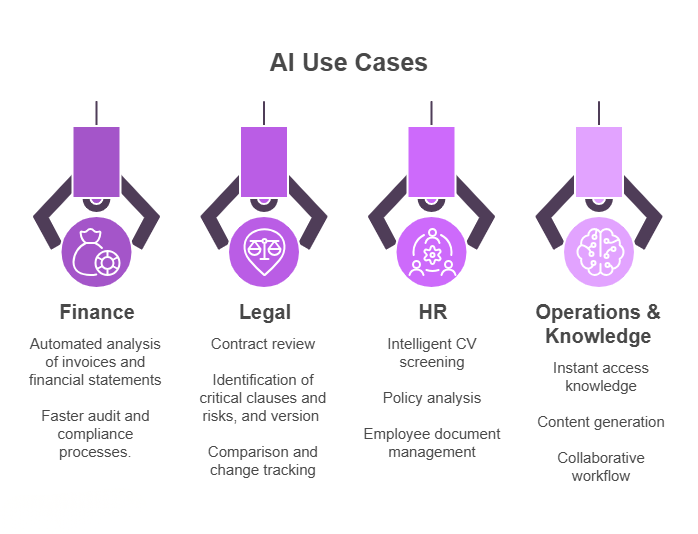
AI-driven document intelligence is already transforming core business processes across industries:
Companies using AI‑driven document automation report higher accuracy and consistency in data extraction, along with fewer manual errors in finance, legal, and HR processing.
Beyond efficiency: a cultural shift
While efficiency gains are compelling, the real transformation happens at a deeper level. Organizations that successfully adopt AI for document management begin to:
- Democratize access to knowledge across teams
- Enable real-time, data-driven decision making
- Transform internal knowledge into a strategic asset
In this context, AI acts as a cognitive layer on top of existing systems—making every document searchable, connected, and alive.
Challenges to address
Like any transformation, this evolution comes with its own set of challenges:
- Data quality: disorganized or inconsistent documents limit AI effectiveness
- Governance and security: managing sensitive information responsibly
- Change management: ensuring adoption across teams
Addressing these requires a structured approach that combines technology, processes, and organizational alignment.
The future: documents that work for people
We are moving toward a future where documents are no longer passive assets, but active participants in business processes:
- They can answer questions
- Continuously update themselves
- Proactively suggest actions
In essence, documents evolve into conversational interfaces to enterprise knowledge.
Conclusion
Applying AI to document management is not just a technological upgrade—it is a strategic enabler of efficiency, accuracy, and innovation. Organizations that embrace this shift can turn a long-standing operational burden into a competitive advantage.
The real question is no longer whether to adopt AI in document workflows, but how quickly companies can unlock the value already hidden within their own information.
Discover more about AI and documents here.