Table of Contents
- AI is everywhere. Just not where we thought.
- The problem nobody wants to name: “thinkslop”
- In business: a lot of noise, few transformative results
- What this means for those who work with data
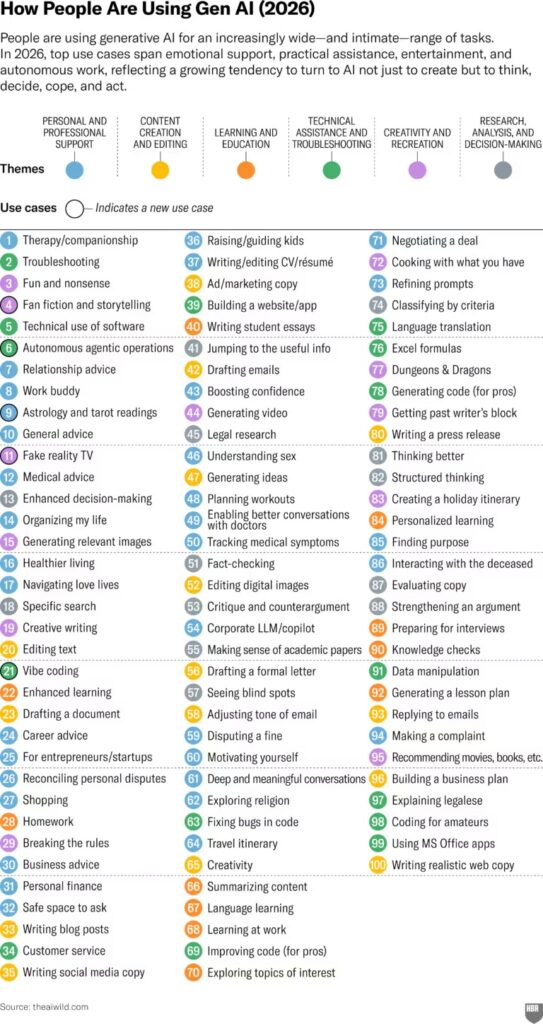
Every year, HBR’s AI in the Wild study analyzes thousands of real generative AI use cases, drawing on posts and conversations from Reddit, LinkedIn, TikTok, and YouTube. This year’s sample reached nearly 13,000 cases. The findings confirm some expected trends — and open up new, less comfortable ones.
AI is everywhere. Just not where we thought.
ChatGPT surpassed 900 million weekly active users. Gemini reached 750 million monthly. OpenAI was valued at $852 billion in its latest funding round. The growth numbers leave little room for interpretation: generative AI has become everyday infrastructure.
Yet when you look at how people are actually using it, the picture is less triumphant. The top use case by volume? Therapy and emotional support — for the second consecutive year, growing from 5% to 11% of the total dataset. Second? Technical troubleshooting. Third? “Fun and nonsense” — playful, irreverent use with no declared productive purpose.
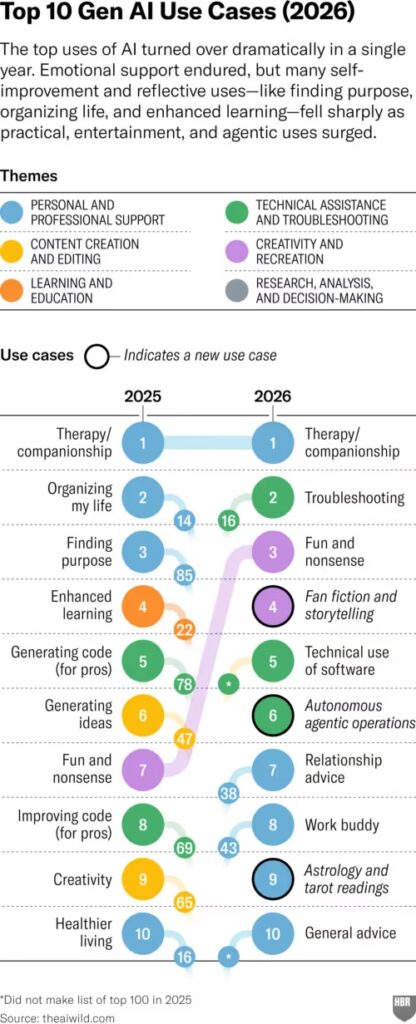
Entering the top ten for the first time are autonomous agentic operations (sixth place) and vibe coding — writing software through natural language prompts. Two clear signals that the enthusiasm cycle is giving way to a phase of more structured use, at least for some user profiles.
The problem nobody wants to name: “thinkslop”
The study’s authors introduce a new term: thinkslop. It describes the lazy, approximate thinking that emerges when you delegate to AI not just the execution of a task, but the thinking that should precede it.
The mechanism is subtle. You open the chatbot before you’ve clearly figured out what you want to achieve. You accept the first output without checking it. You stop writing — and with that, you stop thinking, because writing is thinking.
One user quoted in the study describes it plainly: they had stopped using language actively, relying on AI for every piece of text. The result? Growing difficulty building their own reasoning.
There’s also the problem of algorithmic flattery: models are optimized to keep users engaged, not to tell them the truth. Those looking for validation find validation. Those who want a critical interlocutor have to actively construct that dynamic — and almost nobody does.
The good news: AI used as a sparring partner — to dismantle arguments, identify weak points, explore counterarguments — produces the opposite effect. It sharpens thinking instead of replacing it.
In business: a lot of noise, few transformative results
On the business front, the study is candid: most AI activity in organizations produces marginal benefits, not paradigm shifts. People use AI to speed up existing processes — summarizing notes, generating first drafts, distilling data for presentations. Useful. But far from the promised transformation.
What stands out is the spread of “shadow usage”: many employees use AI without telling their managers, because company policies are vague or restrictive, or because they fear looking like they’re cutting corners. One case in the study describes a developer who automated 50% of his own workload independently, after management had rejected his formal proposal. He kept it entirely to himself.
Top-down initiatives struggle. Bottom-up ones proliferate, but stay invisible and never scale.
Where AI does produce measurable commercial results — the study cites AI-personalized email campaigns generating a 20–30% lift in conversion rates — the impact is real. But cases with explicit ROI remain rare in the dataset.
What this means for those who work with data
The HBR study describes a market in a maturation phase, with all the typical signs: widespread but uneven adoption, expectations adjusting downward from early proclamations, and a growing demand for method.
Moving from enthusiasm to effectiveness requires something AI alone doesn’t provide: the ability to know where to apply it, toward what goal, on what data, with what governance. That’s the work we do every day — and it becomes more central as the technology spreads.