Table of Contents
- Worse than the world it copies
- Why the machine does this
- The business risk people underestimate
- This is an engineering problem, and it is solvable
Ask a generative AI tool for a picture of a doctor and you will most likely get a man. Ask for a cashier and you will most likely get a woman. The chief executive it draws will almost certainly be male, usually white, usually in a suit. The tool is doing exactly what it was built to do. It learned from billions of images scraped off the internet, and it hands that world back to us with the edges sharpened.
A recent Visual Capitalist feature, built on a graphic by NeoMam Studios using data from Kapwing, put this on display for AI-generated video. Across a range of professions the pattern held. High-paying roles such as executives and engineers skewed heavily male, while lower-paying and caregiving roles were far more often shown as women. For anyone building products on top of these tools, that pattern carries real consequences.
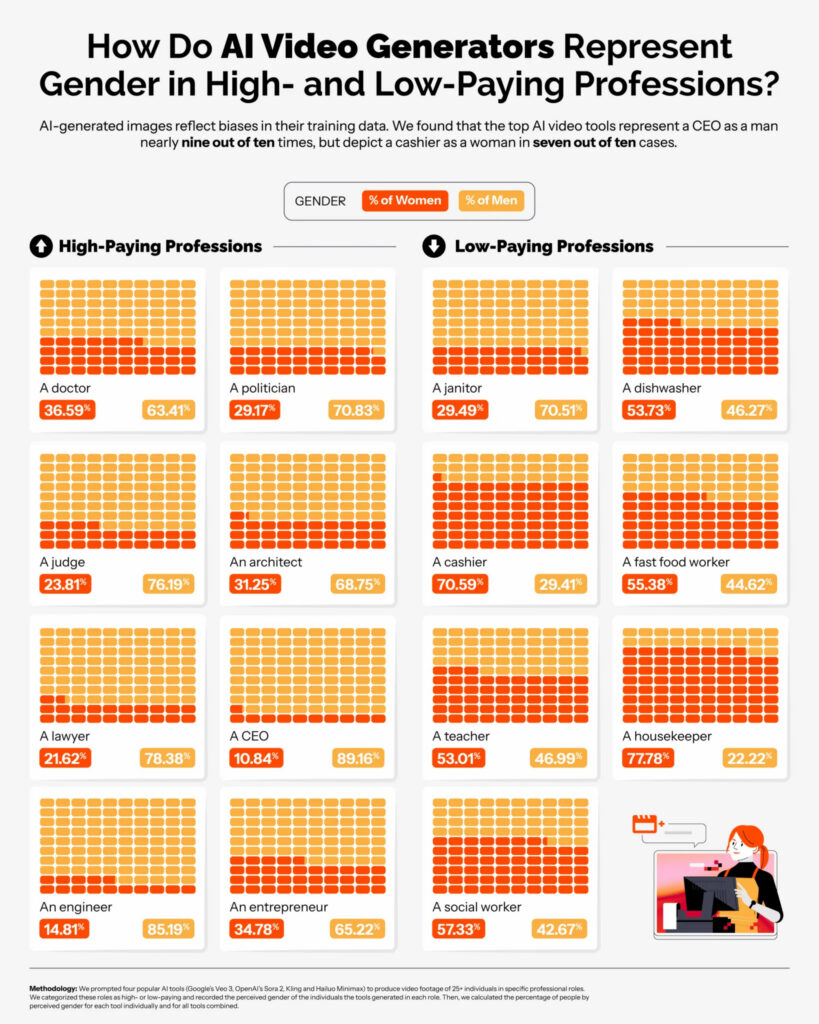
Worse than the world it copies
The uncomfortable part is that generative models do more than reflect the imbalance in the real world. They exaggerate it. Bloomberg analysed more than 5,000 images generated by Stable Diffusion and found the distortions ran further than reality. Around 34% of US judges are women, yet only 3% of the images the model produced for the prompt “judge” were read as female. High-paying job prompts returned mostly lighter-skinned faces, while prompts such as fast-food worker and social worker returned darker-skinned faces far more often than the labour statistics would suggest.
The academic work points the same way. One study found that more than 74% of images generated by DALL-E 3 displayed gender-occupational bias. Earlier research showed the amplification effect in blunt terms: flight attendants are only a slight majority female in real employment data, yet the model rendered them as women in effectively every image.
Healthcare shows how specific this gets. A study that generated 1,200 images of doctors across 30 specialties found 82% of the AI faces were male, against 47% in the actual NHS workforce. The tools produced no images at all of female GPs or orthopaedic surgeons, while overrepresenting women in dermatology and obstetrics.
Why the machine does this
The cause is not mysterious. These models are trained on enormous collections of text and images pulled from the open web, and the web carries decades of unequal representation. The model learns a shortcut instead of a nuanced distribution, and at generation time it plays that shortcut back louder than it heard it. The minority case shrinks until it disappears.
Brookings and others have documented how consistent this is across tools and prompts. The technology has no intent to discriminate, yet its output does, which is exactly why the problem is easy to ship without noticing.
The business risk people underestimate
It is tempting to treat this as an abstract fairness debate. In practice the outputs travel. AI-generated images already feed advertising campaigns and corporate presentations, and AI-generated video is heading the same way fast. Every time a company reaches for a quick generated visual of a “leader” or a “customer”, it risks publishing the stereotype without meaning to.
There are two costs here. The first is reputational and legal. Audiences and regulators are paying closer attention to how brands represent people, and a biased image library is a liability waiting to surface. The second cost is quieter and more corrosive. When people repeatedly fail to see themselves in a role, the message that they do not belong there gets reinforced. A tool used millions of times a day becomes a machine for narrowing what a profession is allowed to look like.
This is an engineering problem, and it is solvable
None of this is a reason to walk away from generative media. It is a reason to build and deploy it responsibly, and the levers are well understood.
Bias can be measured. Rather than trusting the output, teams can generate at volume and compare the results against real-world baselines the way the studies above did, turning a vague worry into a number they can track over time. Training and fine-tuning data can be curated and rebalanced so the model sees a fuller range of people in every role. Prompts and outputs can be tested before anything ships, with a human in the loop for the uses that carry weight. And systems can be honest about their limits, flagging when a request sits in territory where the model is known to distort.
This is the standard we hold ourselves to at Neodata. Building AI systems for video and data means treating fairness as part of quality rather than an afterthought, and measuring it with the same rigour as accuracy or speed. A generative system that quietly rewrites who belongs in which job is not a finished product, however impressive the images look.
If your organisation is putting generative images or video in front of customers, it is worth knowing what those systems are representing on your behalf. We are happy to talk it through.