Table of Contents
- What Gartner means by AI debt
- Why ignoring it is the real risk
- How to keep AI debt under control
- Where Neodata fits
Most AI projects look healthy the day they go live. The trouble starts later, when the shortcuts that got them shipped fast begin to cost more than they saved. Data pipelines that were quick to stand up become expensive to change, and the models running on them quietly drift while governance falls behind. The speed you felt at the start turns into a bill, and the bill keeps growing.
Gartner has a name for this problem: AI debt.
What Gartner means by AI debt
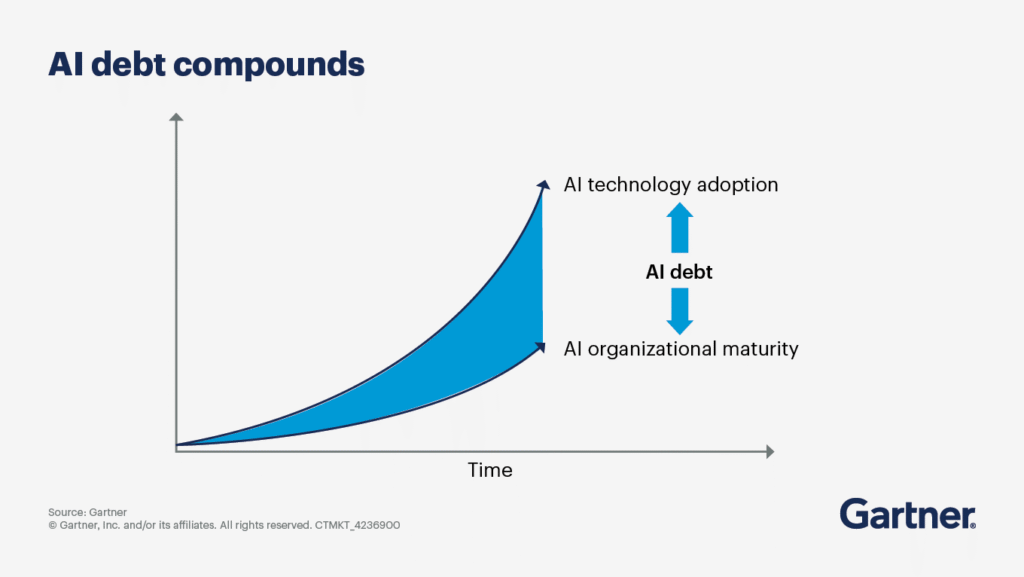
In a Gartner article, the analyst Anthony Mullen defines AI debt as the accumulated cost of past decisions, intentional or not, that favor short-term AI gains over long-term sustainability. Those decisions leave you with future burdens such as rework, hidden inefficiencies, new risks, and value you can no longer capture.
The uncomfortable part is that no one is exempt. Gartner notes that every organization accumulates AI debt as it scales, whatever its industry, size, or level of maturity. If you are running AI in production, you are taking on debt, because AI systems move faster than the data, teams, and controls built to support them.
This pattern is already well documented in software engineering. McKinsey estimates that technical debt can absorb 20% to 40% of the value of a company’s entire technology estate, and developer research shows teams losing roughly a third of their time to servicing it. AI adds a faster-moving layer on top of that, which is why the debt builds up more quickly than most teams expect.
Gartner lays out a few hard truths about how this debt behaves:
- It is inevitable: Any real AI deployment carries technical, organizational, and cultural debt. Its presence signals progress rather than failure.
- It grows with every innovation cycle: Each new model or use case tends to reward speed over integration and governance, adding dependencies underneath the surface.
- It compounds when left alone: Debt from one cycle stacks on the debt from the last, and the result is delays, weaker performance, and a heavier oversight load.
- It spreads: A gap in one area rarely stays put. It ripples outward and forces a fix at the system level.
Why ignoring it is the real risk
Gartner uses a financial analogy that lands well. As AI debt piles up, it drains your liquidity. You lose the room to pivot and scale, because too much of your capacity is tied up servicing decisions you made months or years ago. Keep ignoring it, and localized patches start reinforcing the very constraints you are trying to escape.
The warning signs already show up in the data. In a Gartner survey of 782 infrastructure and operations leaders in late 2025, only 28% of AI use cases fully met their ROI expectations, 20% failed outright, and 57% of leaders reported at least one failure of their own.
MIT research from 2025 was blunter still, finding that around 95% of organizations deploying generative AI saw no measurable return. RAND has put the overall AI failure rate above 80%, roughly twice that of conventional IT projects. Much of this traces back to weak foundations rather than weak models, and Gartner expects 60% of AI projects to be abandoned by the end of 2026 for lack of AI-ready data.
The counterintuitive lesson from Gartner is that the goal is not zero debt. Some AI debt is worth carrying, as long as it sits in the right places and stays within a level you have consciously chosen. What hurts is the debt you never named, never measured, and never planned to repay.
The payoff for handling it well is significant. Gartner reports that organizations taking a deliberate approach to managing AI debt can mature up to 500% faster over the next three years, while extracting more value from what they build.
How to keep AI debt under control
Gartner recommends treating AI debt as a strategic issue that spans the whole organization, rather than a cleanup job left to engineers. A few principles stand out:
- Design for sustainable debt, so it lives where you want it and at a level you can afford.
- Get senior leaders fluent in it, so trade-offs are made on purpose instead of by accident.
- Build debt checks into the AI lifecycle, so every new use case accounts for the debt already on the books.
- Tie repayment to business outcomes, so fixing a fragile data workflow visibly shortens time to value.
The upside is measurable. McKinsey has found that organizations actively managing technical debt free up as much as 50% more engineering time for work that moves the business forward. The same discipline applied to AI is what separates the teams that keep scaling from the ones that stall.
Where Neodata fits
Managing AI debt comes down to how systems are engineered in the first place. That is the part Neodata has been working on for more than twenty years, well before AI became a headline. Across Video Intelligence, Document Intelligence, Data Intelligence, and AI Assistants, we build AI that is meant to run in production and hold up over time, with the data foundations and governance that keep short-term wins from turning into long-term liabilities.
If your AI initiatives are moving quickly and you want to be sure the debt underneath stays sustainable, we are happy to talk it through.