Table of Contents
- 1. The value is there, but it is hard to measure.
- 2. Agentic AI carries more and more weight.
- 3. Agents are growing faster than the controls.
- 4. 70% of the work concerns people.
- 5. The advantage has shifted to data.
- 6. The right cost is cost per outcome.
- 7. The winners are faster and more focused.
- 8. Sector does not decide the outcome.
Many companies have already put an agent into production. Few can say what it is worth on the balance sheet, and even fewer have set up controls for when that agent has to decide on its own.
That is the picture emerging from BCG’s Applied AI Index 2026, a survey of 1,330 executives across more than 20 sectors. We have pulled out the most useful data for anyone deciding where to invest over the next twelve months.
1. The value is there, but it is hard to measure.
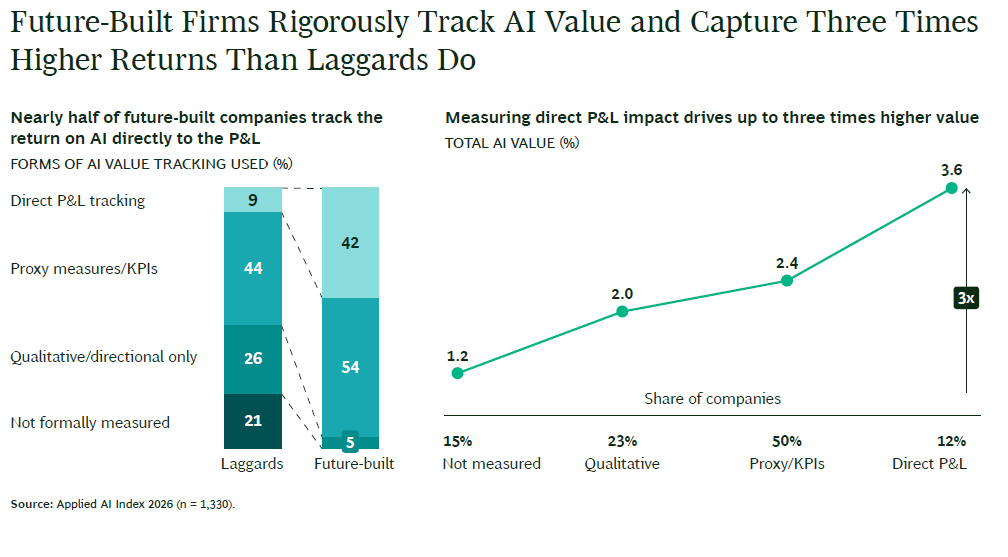
Almost half of companies already generate measurable value from AI, and nearly nine in ten CEOs see cost or revenue benefits. Only 14% of them, however, have defined the P&L impact of each initiative.
The report divides companies by maturity. Among the most mature, the future-built (7.5% of the sample), 95% use clear KPIs or track value directly on the P&L. Among the least mature, the laggards, 47% assess it qualitatively at best. The difference shows in the results: companies that track impact directly on the P&L obtain up to three times the value of those that do not measure. The advantage grows when measurement is combined with a clear strategy: companies with both strategic clarity and applied AI obtain five times the value (4.5% of revenue) of those with neither (0.9%).
2. Agentic AI carries more and more weight.
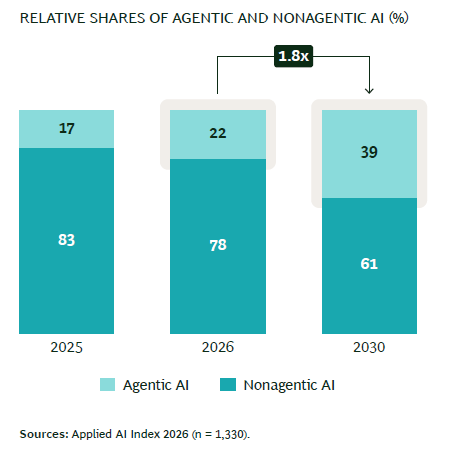
The share of agentic value rose from 17% in 2025 to 22% in 2026 and, according to the report, will reach 39% in 2030. Among the future-built, 44% already report full value from agents, against 2% of laggards.
3. Agents are growing faster than the controls.
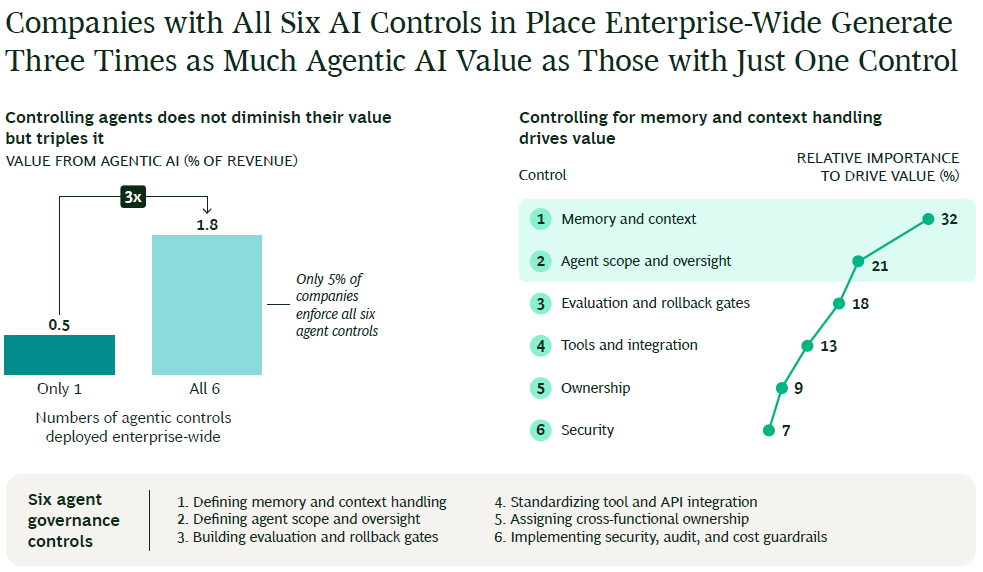
42% of companies expect their agents to act autonomously by 2030, for example by making decisions without human approval. Only 5% have the controls in place today to do so safely.
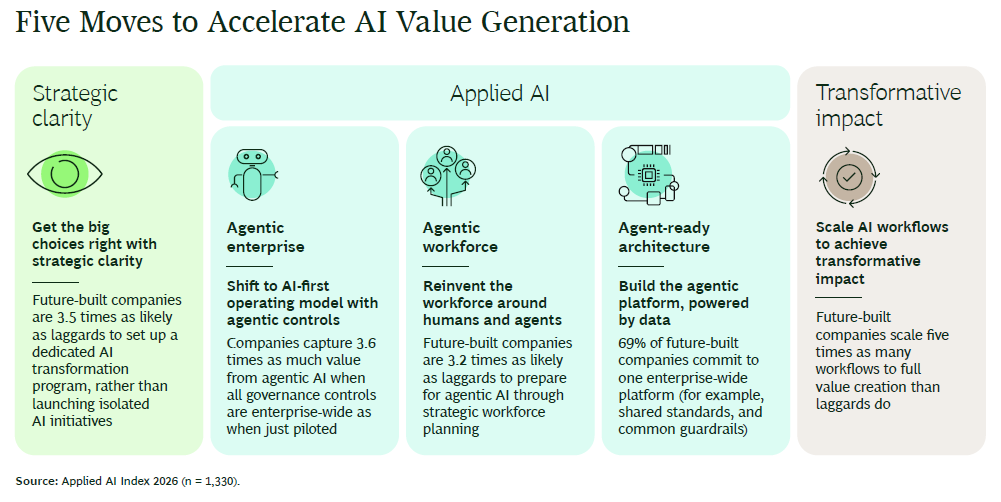
Controls do not slow value down; they increase it. Companies that apply all of them at enterprise level obtain 1.8% of revenue from agentic AI. Those that apply only one stop at 0.5%. The six controls BCG identifies are: memory and context, scope and oversight, evaluation and rollback, tool integration, accountability, and security.
Of the six, the most decisive is memory and context, that is, the rules on what an agent remembers and reuses from one task to the next. On its own, it explains 32% of the value the controls generate.
4. 70% of the work concerns people.
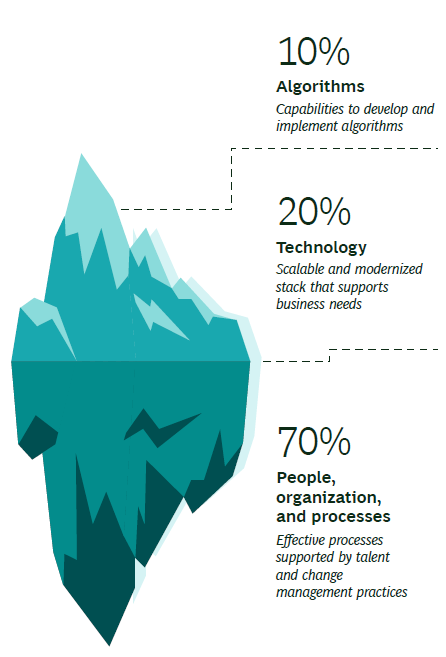
The 10-20-70 rule: 10% of the effort goes to algorithms, 20% to technology and data, and the rest to people, organisation and processes. 55% of the future-built carry out strategic workforce planning, against 17% of laggards. 89% of companies expect AI to create new work; the expected reduction is 10-15%, concentrated in the middle layers. A team of 1,000 engineers with productivity stuck at +10% raised its power users from 5% to 50% with six weeks of coaching.
5. The advantage has shifted to data.
Cloud and databases are now widespread. Data structuring and access controls are also present in 58-72% of companies, at every level of maturity. Today the difference comes from data quality: data must be up to date, defined uniformly across the whole company and assigned to an owner.
95% of the future-built have launched a data transformation project, against 74% of laggards. 70% of the future-built extend it across the whole company, against 43% of laggards. They are also 40% more likely to give agents real-time access to company data, so that answers are based on current information, and 70% more likely to have explicit rules on what each agent can see and do.
6. The right cost is cost per outcome.
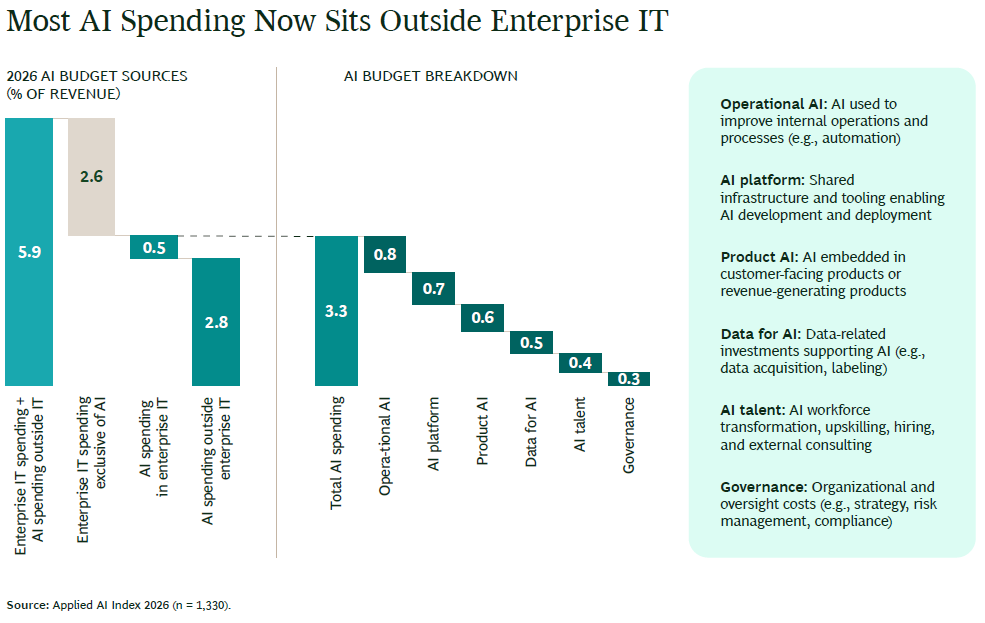
Spending on AI has more than tripled in a year: from about 1% of revenue to 3.3% today. Much of this spending sits outside the IT budget, where it amounts to 2.8% of revenue, against 0.5% inside IT. This makes it harder to know how much is really being spent.
75% of the future-built have explicitly decided how to manage token spend and govern it against a stated return. Among laggards, half grant access to tools without tracking spend, or monitor it without setting a cap.
The report also proposes changing the unit of measurement: cost per outcome achieved, instead of cost per token. A more capable model that completes the task on the first attempt can cost less than a cheaper one that has to retry or requires human review.
7. The winners are faster and more focused.
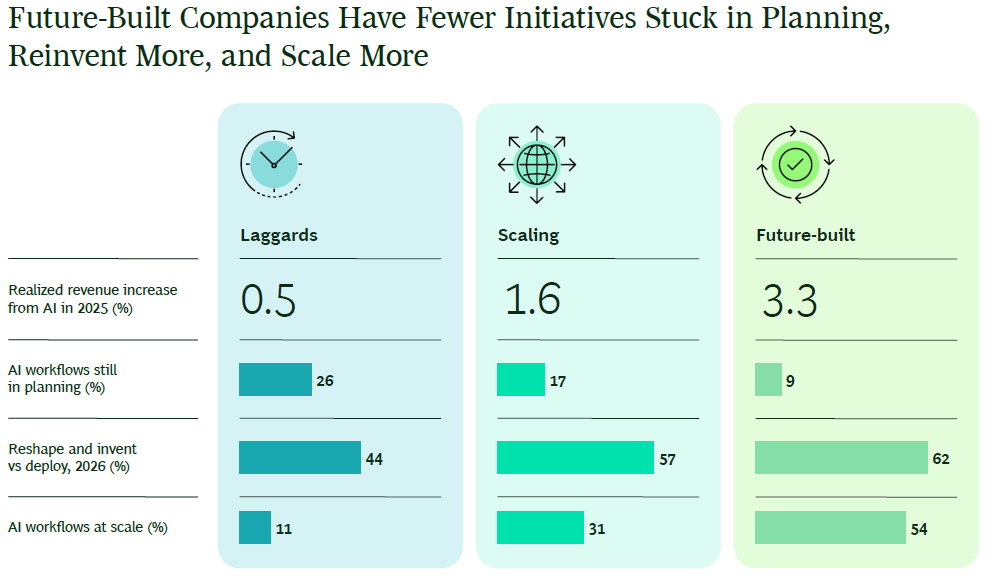
The future-built reach P&L impact in about 11 months, including full process redesign. Companies in the scaling phase take 14, and laggards 17.
They also have 20 workflows in production at scale, against 4 for laggards, despite starting from an initiative portfolio only 1.5 times larger. 62% of their initiatives redesign or invent processes, against 44% for laggards, who tend instead to apply AI to what already exists. They concentrate resources on a few high-value functions. The gap with laggards is widest in R&D: 61 percentage points.
8. Sector does not decide the outcome.
According to the report, all of the more than 20 sectors analysed include at least one future-built company. This suggests that a high level of AI maturity can be reached in any sector. The share of leaders, meaning future-built or scaling companies, varies: 70% in technology, 46% in machinery.
The economic advantage, by contrast, appears similar everywhere. In every sector, BCG finds that leaders generate two to three times the value of laggards, considering both cost reduction and revenue growth. Laggards, in turn, are a heterogeneous group, with some companies close to the leaders and others far behind. For this reason, the most useful comparison seems to be with the leaders, rather than with the average of one’s own sector.
On where to invest, too, the report points to a common trend. Between 54% and 78% of AI value is concentrated in core functions and, in almost every sector, technology/IT and R&D rank first or second. BCG suggests avoiding generic adoption and focusing on the two or three functions that matter most in one’s own sector.
If you are launching an AI project and facing these questions (measuring value, putting controls on agents, preparing data), Neodata works alongside companies throughout the journey, from defining use cases to going into production.