Table of Contents
- The Split Is Getting Wider
- Four Conditions That Drive AI FoMO
- It Goes Deeper Than Job Loss
- The Training Gap Organizations Are Ignoring
- 2026 Is the Inflection Point
There’s a specific kind of anxiety spreading through organizations right now. Not the fear of AI taking over — something subtler. The feeling that everyone else is figuring out how to work with AI while you’re still catching up. Researchers call it AI FoMO: Fear of Missing Out, applied to the workplace. And in 2026, the window to address it is narrowing.
The Split Is Getting Wider
The OECD’s workplace AI study surveyed workers in finance and manufacturing who had been using AI systems daily for extended periods. These weren’t people encountering AI for the first time. The results still showed a persistent split: most workers recognized productivity gains, better working conditions, and fairer management. But a significant share reported fears of job loss, wage stagnation, and reduced autonomy — precisely because they could see what AI was doing around them.
That split hasn’t healed. A March 2026 national survey by Jobs for the Future found that worker sentiment had actually reversed compared to a year earlier. More workers now say AI does more harm than good to job prospects and quality of life. Among those surveyed, 47% reported needing to acquire new skills because of AI, while just 7% said AI was not significantly changing the importance of any skills — down from 42% the year before.
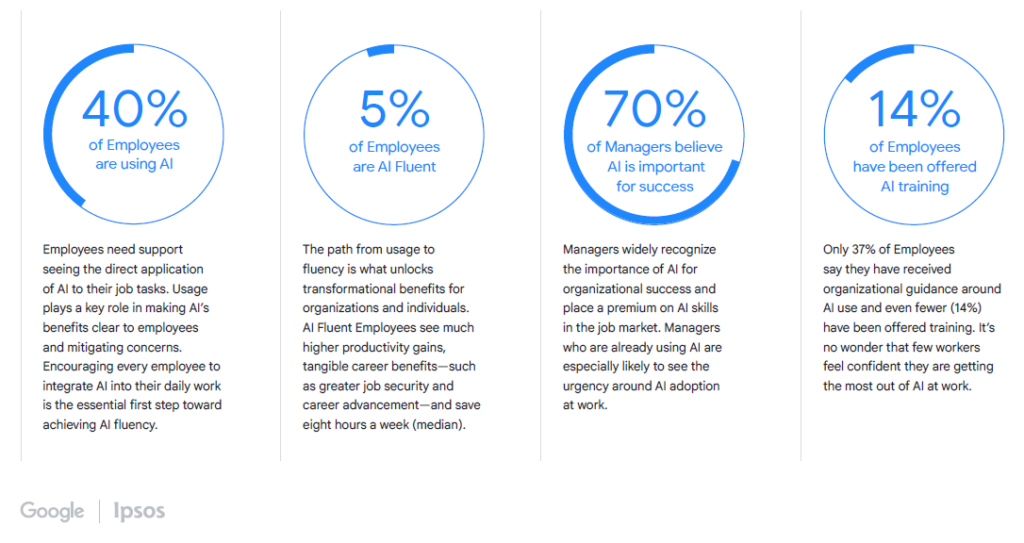
A February 2026 Google/Ipsos study of over 4,400 employed Americans adds a sharper picture of where the market actually stands. Four in ten employees now use AI at work — but only 5% qualify as truly “AI Fluent,” meaning they have redesigned significant portions of their work processes using AI. The remaining 35% are “AI Explorers”: occasional users applying AI to isolated tasks, with no structured approach. The majority, 60%, don’t use AI at work at all.
The gap between where workers are and where organizations expect them to be is not a perception problem. It’s structural.
Four Conditions That Drive AI FoMO
A study published in late 2025 applied Fuzzy Set Qualitative Comparative Analysis to the OECD dataset and identified four specific workplace conditions that combine to produce AI FoMO: perceived loss of decision-making autonomy, concerns about AI-driven supervision (the so-called “robo-boss” effect), the belief that certain skills are becoming less valuable, and the mental health pressure of constant adaptation. These conditions don’t operate independently — combinations of skill devaluation, lost autonomy, and concerns over AI supervision are the key drivers. Remove one and the others lose some of their force.
The anxiety doesn’t require a triggering event. Employees experience ongoing job insecurity even when they haven’t directly suffered any negative consequences from AI adoption. What feeds it is the absence of clarity — about what AI decides, what it doesn’t, and what role human judgment still plays.
It Goes Deeper Than Job Loss
AI FoMO is often framed as fear of replacement. That framing is incomplete. A 2026 Frontiers in Psychology study introduced the concept of “algorithmic anxiety” — a broader syndrome encompassing not just job loss fears but deeper concerns about professional identity and the meaning of work in an automated environment. Workers aren’t only afraid of losing their jobs. They’re afraid of losing their sense of competence.
This distinction has practical consequences. An employee who fears replacement might be reassured by data showing their role isn’t being automated. An employee experiencing algorithmic anxiety needs something different: visibility into how AI decisions are made, proof that their judgment still plays a role, and the experience of being skilled in working alongside AI rather than subordinate to it. These require different interventions.
The Google/Ipsos data makes the stakes concrete. AI Fluent employees save a median of 8 hours per week through AI use. AI Explorers save 3. Beyond productivity, AI Fluent employees are 3.5x more likely to report improvements in job security, 4.5x more likely to report receiving higher compensation, and 4x more likely to have received a promotion. The difference between those two groups is not intelligence or work ethic. It’s structured exposure, training, and organizational support.
The Training Gap Organizations Are Ignoring
The Google/Ipsos report is especially direct on one point: organizations are not doing the work. Only 14% of employees say their organization has offered AI-related training in the past 12 months. Only 37% say they’ve received any guidance on how to use AI at work. Just 22% have access to both AI tools and organizational guidance simultaneously.
Employees who have access to tools and guidance are 2.5x more likely to be AI users and 4.5x more likely to reach AI fluency. Those who receive formal training are 2.5x more likely to use AI and 3.5x more likely to become fluent. The formula isn’t complicated — but most organizations haven’t executed it.
Meanwhile, 70% of managers already believe AI skills are important for their organization’s success over the next five years, and 70% view AI skills as either a requirement or a preference when hiring. The expectation is already baked into hiring decisions. The training to meet it largely isn’t.
2026 Is the Inflection Point
AI deployment is no longer experimental. Organizations that were piloting tools in 2023 and 2024 are now integrating them into core workflows. The companies that invested early in structured adoption programs — communication, training, human oversight by design — are now seeing compounding returns. Those still improvising are accumulating a different kind of debt: not technical, but organizational.
AI-induced FoMO as a direct factor in adaptation speed, not just morale. Employees under high FoMO avoid tools or use them superficially, limiting ROI. They spend cognitive energy on worry rather than learning. They’re more likely to leave roles that feel exposed. Unchecked AI anxiety doesn’t stay in the psychological domain — it shows up in adoption rates, productivity metrics, and attrition numbers.
At Neodata, we work with organizations building AI into data and media operations. What we observe consistently is that the technical layer is rarely the bottleneck. The bottleneck is organizational — how AI capabilities are communicated, who gets trained, and whether people have enough visibility into how systems make decisions to trust them. Addressing AI FoMO isn’t a separate initiative from AI adoption. It’s the same work.
The question for leadership in 2026 is straightforward: are your people equipped to work alongside AI in a way that strengthens their position, or are they watching from the outside, waiting to see what happens next?