Table of Contents
- The real shift: from adoption to transformation
- Where transformation is already happening
- Three structural shifts no organization can avoid
- The real enabler: organizational design
- Final takeaway
In the past few years, artificial intelligence has moved from experimentation to execution. Yet many organizations are hitting the same wall: the real constraint is no longer the technology itself, but how the organization is designed to use it.
The latest white paper from the World Economic Forum, in collaboration with Accenture , puts this challenge into sharp focus. The question leaders should be asking is no longer “Does AI work?” but rather “Are we structured to make it work at scale?”
For most, the answer is still unclear.
Only about 15% of organizations are using AI to redesign how work gets done fundamentally. The rest are layering AI on top of existing processes—often reinforcing inefficiencies instead of removing them.
The real shift: from adoption to transformation
Many companies have already seen success with AI pilots: chatbots, predictive models, and targeted automation. But these initiatives often remain isolated.
The real inflection point comes when AI stops being a project and becomes part of the operating backbone. Not a set of tools, but a system that continuously shapes decisions, workflows, and value creation.
Where transformation is already happening
Leading organizations are rebuilding core functions from the ground up.
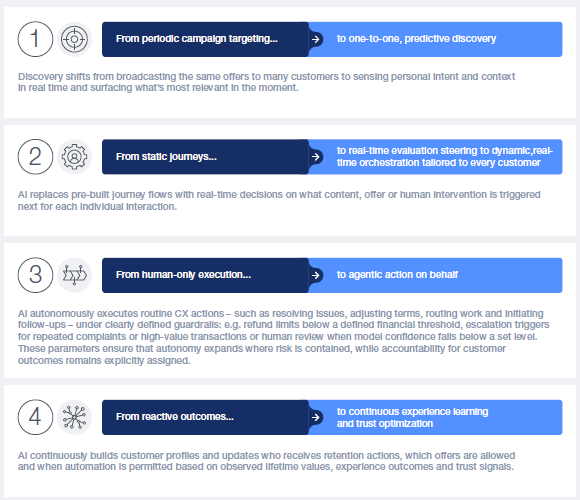
Customer Experience
Customer journeys are no longer linear or predefined. AI enables real-time orchestration, identifying latent intent and acting in the moment. Instead of pushing campaigns, organizations respond dynamically, meeting needs as they emerge.
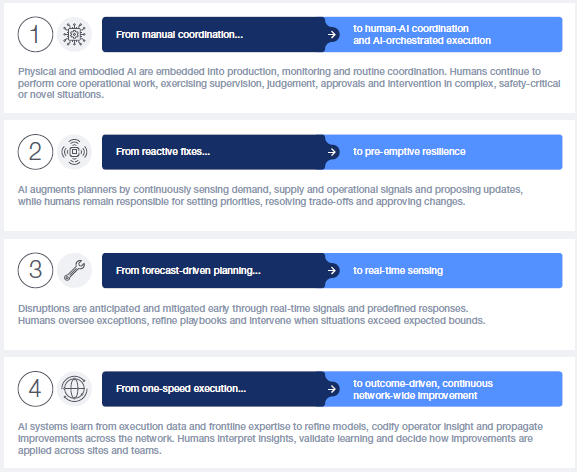
Operations
Execution is shifting from forecast-driven to sensing-driven. AI-powered systems detect disruptions early and adapt in real time. Supply chains and production environments become responsive, continuously recalibrating rather than reacting.
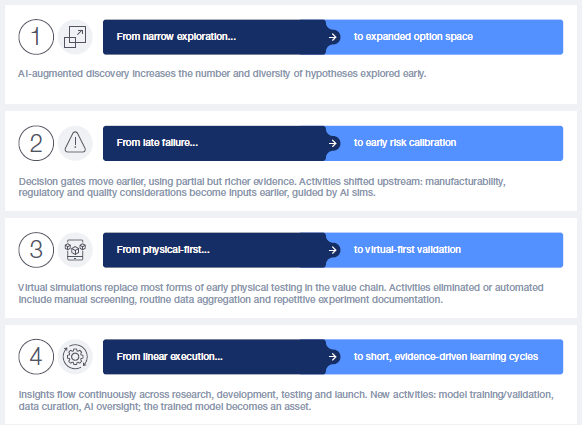
R&D
Innovation is becoming a continuous learning cycle. AI allows early-stage validation through simulation and digital twins, dramatically reducing time and cost. The traditional pipeline gives way to faster, more iterative discovery.
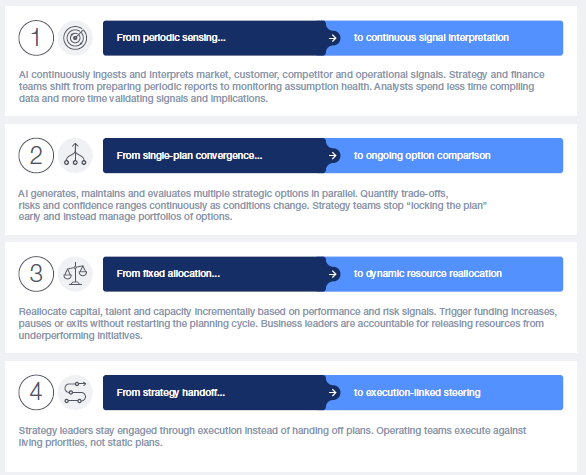
Strategy
A living system is replacing the static annual plan. AI continuously interprets signals from the market, enabling organizations to manage a portfolio of strategic options and reallocate resources dynamically.
Talent
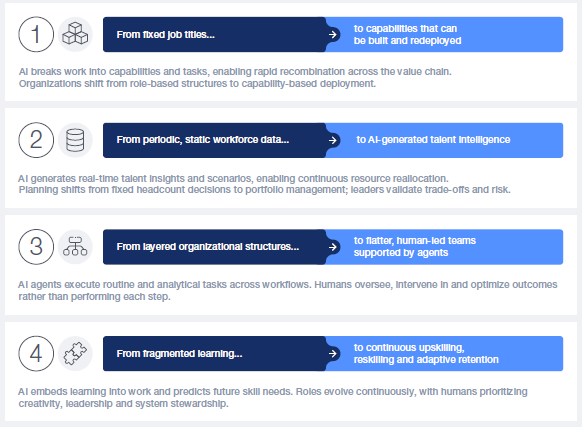
Work is no longer defined by static roles. AI breaks down activities into capabilities, identifying adjacent skills and enabling internal mobility. Organizations unlock hidden capacity by matching people to opportunities in real time.
Three structural shifts no organization can avoid
Across these transformations, a common pattern emerges. Scaling AI requires three fundamental transitions:
From isolated use cases to connected systems
Functional silos become barriers. Data, logic, and decision-making must flow across the organization.
From episodic processes to continuous systems
Periodic reviews and crisis-driven alignment give way to always-on loops: sensing, deciding, learning.
From task automation to human value creation
AI takes over execution and data synthesis. Humans move toward higher-value activities, judgment, orchestration, and accountability.
The real enabler: organizational design
Technology alone does not create an advantage. Without structural change, it often amplifies existing limitations.
Organizations that are successfully scaling AI share a few key principles:
- Human-in-the-loop, by design: decision rights and autonomy thresholds are clearly defined upfront
- End-to-end ownership: fewer handoffs, greater accountability for outcomes
- Transparency as an accelerator: trust and explainability enable speed, not friction
- Disciplined experimentation: failure is structured, and learning is systematically captured
Final takeaway
Underinvesting in AI is not the real issue. The greater risk lies in investing without reshaping how the organization functions.
Falling behind will rarely be the result of technology not delivering. More often, it will stem from operating models that failed to keep pace.
Ultimately, this is less about technology and more about leadership, about the ability to drive change, rethink processes, and align the organization around new ways of working.