Table of Contents
- AI adoption: a step forward… but not yet a full run
- AI agents: the next frontier of intelligent automation
- Economic value: innovation is rising, but EBIT is not increasing significantly yet
- Who wins with AI? High performers show the way
- Impacts on work and risk management: new skills and growing awareness
- Conclusion: those who truly want to compete can no longer wait
In 2025, the adoption of artificial intelligence accelerated significantly among companies.
Yet while the use of AI in operational functions is expanding, a key insight is emerging: most organizations are still stuck in the experimentation phase.
This is one of the central findings of the new McKinsey report “The State of AI in 2025: Agents, Innovation, and Transformation,” which provides an updated picture of how companies are integrating AI and extracting strategic value from it.
AI adoption: a step forward… but not yet a full run
According to McKinsey, 88 percent of companies now use AI regularly in at least one function, a clear rise from 78 percent last year. Adoption is broad, but maturity remains uneven:
- Only one-third of companies have begun to scale their AI programs at the enterprise level.
- Two-thirds are still in the testing or proof of concept phase, without a clear strategy for large-scale adoption.
- Larger companies, both in revenue and workforce size, are the most advanced: almost half of those with more than five billion dollars in revenue have reached the scaling stage, compared to only twenty-nine percent of those below one hundred million.
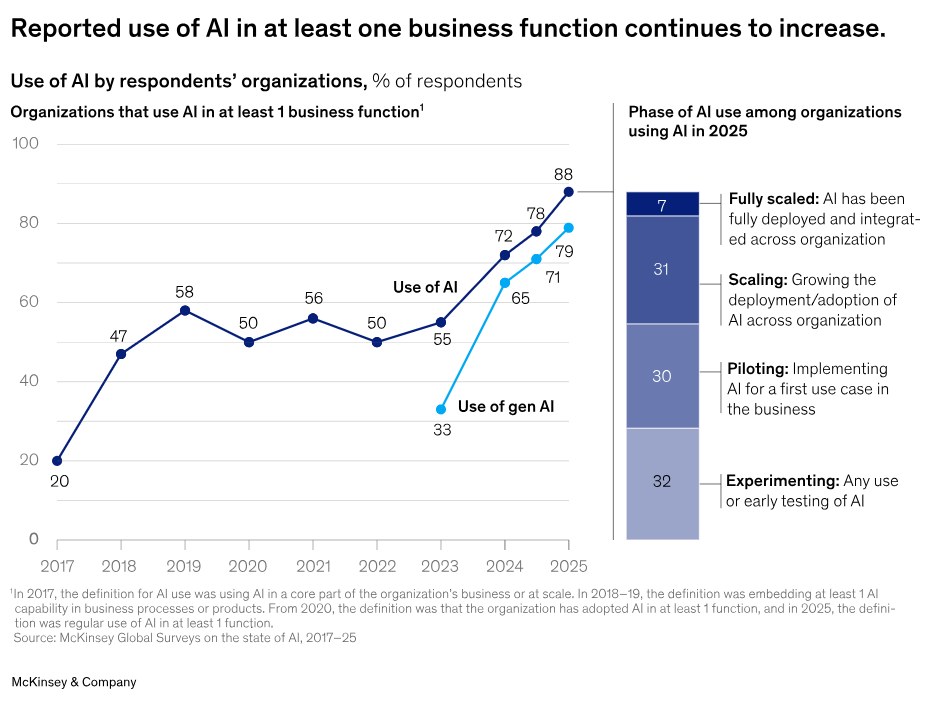
AI adoption is also becoming increasingly multifunctional: 68 percent of companies use AI in more than one function, and 50 percent in three or more, with IT, knowledge management, marketing, and sales at the top.
AI agents: the next frontier of intelligent automation
One of the most relevant developments of 2025 is the rise of AI agents, systems based on foundation models capable of acting in the real world, planning, and completing multi-step tasks autonomously.
Here are the key findings:
- 62% of companies have already begun experimenting with AI agents.
- 23% have moved beyond experimentation and started deploying them at scale, although often limited to one or two functions.
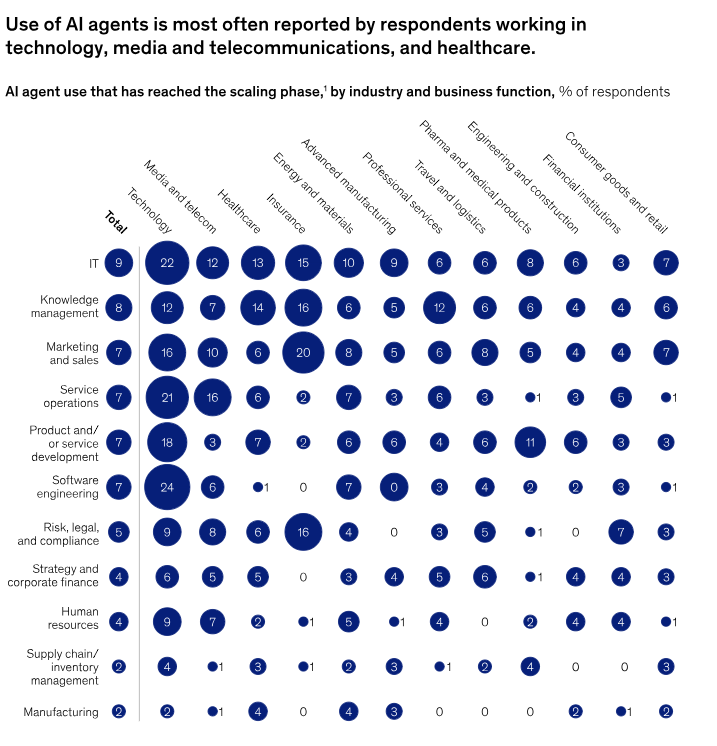
However, in no business function have more than ten percent of companies scaled these agents, a sign that we are still at the early stages.
The sectors that adopted these technologies first include:
- IT, for example, service desk automation, technical triage, and user support
- Knowledge management, for example, advanced search, document retrieval, and automated synthesis
- Leading industries include technology, media, telecommunications, and healthcare.
Economic value: innovation is rising, but EBIT is not increasing significantly yet
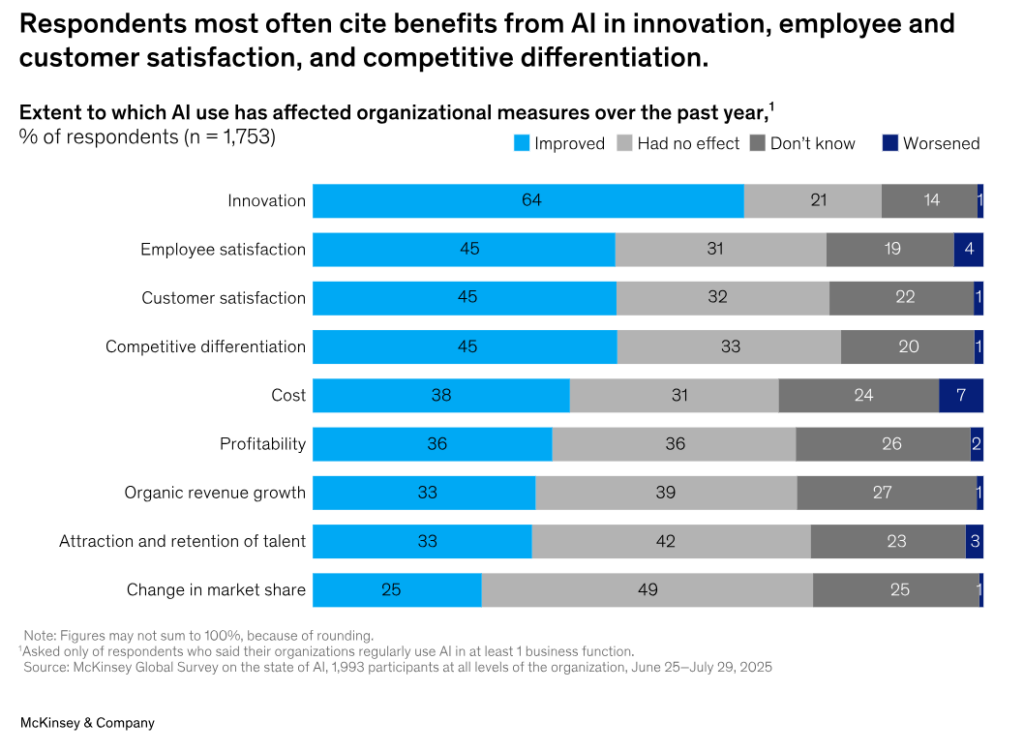
A central question in the report is whether AI is generating measurable benefits. The answer is yes, but with important nuances.
Thirty-nine percent of respondents state that AI has generated an impact on company EBIT.
But in most cases, less than five percent of total EBIT is attributable to AI.
However, the qualitative benefits are clear:
- 64% report improvements in innovation
- 45% report increased customer satisfaction
- Another 45% percent recognize a tangible competitive advantage
The functions producing the greatest impact include:
- Cost reduction: software engineering, IT, production
- Revenue generation: marketing and sales, strategy and corporate finance, product and service development
Who wins with AI? High performers show the way
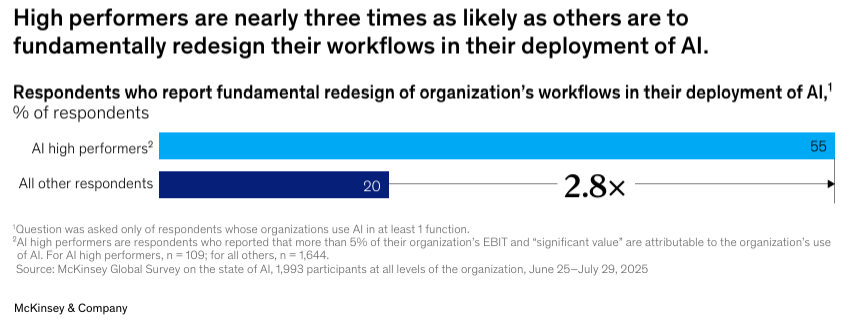
McKinsey identifies a group of companies that stand out clearly: those that attribute at least five percent of their EBIT to AI and derive meaningful value from it. These organizations share several characteristics:
- Transformative ambition
While eighty percent of companies treat AI as a tool for efficiency, high performers use it to grow, innovate, and rethink the business. They are three times more likely to use AI to drive radical transformation. - Redesign of workflows
These companies do not limit themselves to automating processes. They rethink them from scratch, integrating AI into workflows and decision-making systems. - Active leadership and strategic vision
High performers are three times more likely to report strong commitment from top leadership, which consistently and transparently supports AI initiatives. - Significant investments
One third of these companies allocate more than twenty percent of their digital budget to AI, compared to only seven percent of other organizations. - Advancement in the use of agents
They are three times more advanced in scaling AI agents than the average. Many employ them across multiple operational functions, offering continuous support to human work. - Adoption of the Rewired model best practices
From strategy to governance, from data to operating models and training, these companies adopt solid and structured approaches to integrate AI sustainably. A key element is the human in the loop practice, which helps determine when human oversight is needed to validate or supervise model outputs.
Impacts on work and risk management: new skills and growing awareness
The report also explores how AI is influencing the workforce and how companies are managing emerging risks.
- 43% of companies do not expect major changes in their workforce
- 32% foresee a reduction, while thirteen percent expect an increase
Demand for AI-related skills is rising, especially for software engineers and data engineers, a trend even stronger among large companies
On the risk side:
- Companies now manage an average of four AI-related risks, compared to two in 2022
- 51% have already experienced negative effects linked to AI
- The most common problem is inaccurate results, followed by compliance and intellectual property issues
High performers, though more exposed, are also better at mitigating risks: structured AI governance, auditing, and validation make a decisive difference.
Conclusion: those who truly want to compete can no longer wait
McKinsey closes with an effective metaphor:
“If AI adoption were a marathon, many companies have just reached the starting line. They have the right shoes, meaning the tools, but they still need to change their running style, meaning the processes, hire a coach, meaning active leadership, and develop a strategy to complete the race competitively.”
For those leading innovation within organizations, the message is clear: testing AI is not enough. It must be integrated in a systematic, strategic, and responsible way. Only then can it evolve from a promising technology into a concrete lever for growth, differentiation, and long-term value.